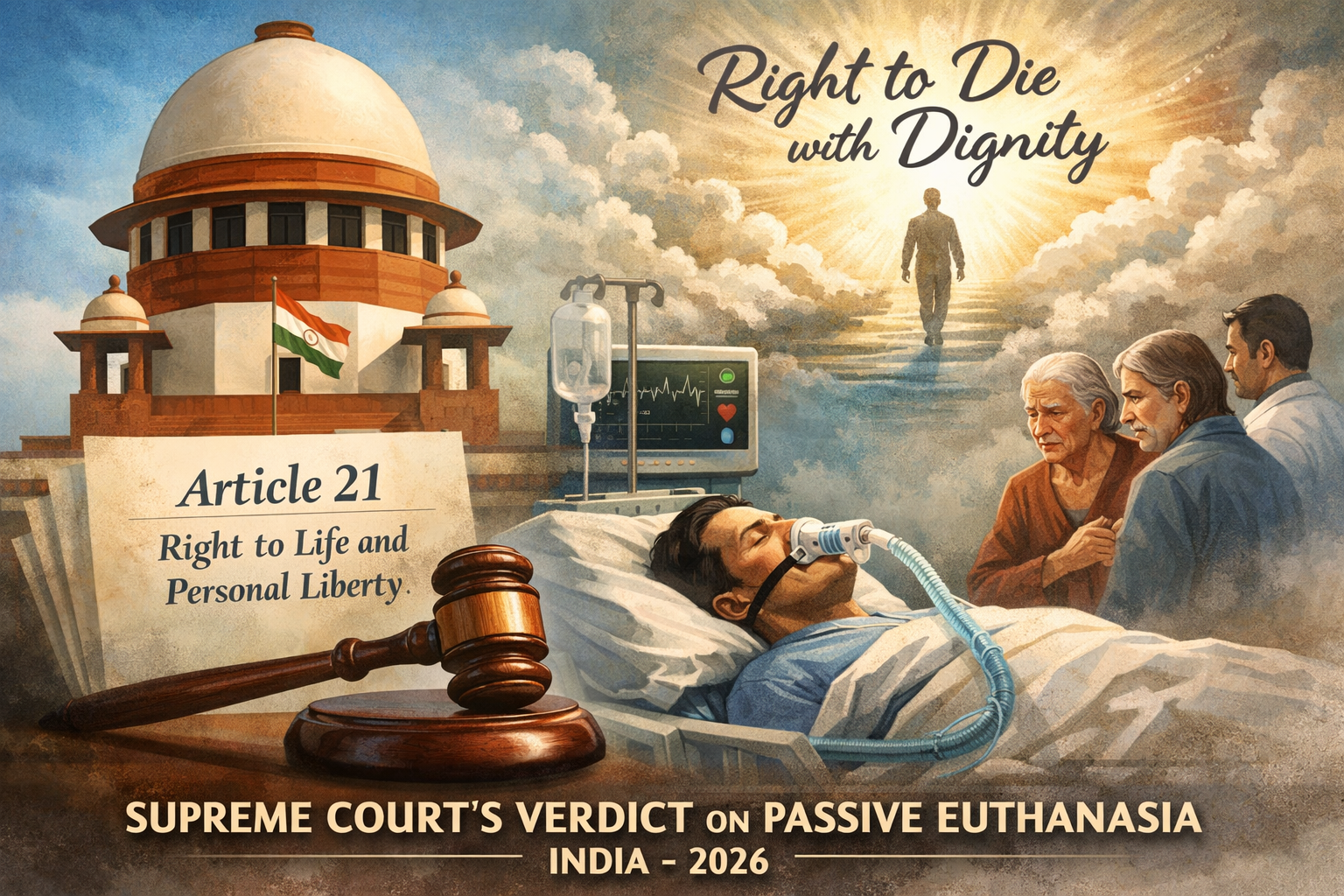
Euthanasia and Right to Die with Dignity in India
Ethical, Legal and Social Dimensions
Introduction
The Supreme Court’s recent judgment in Harish Rana v. Union of India (2026) has reaffirmed the right to die with dignity under Article 21. By allowing withdrawal of life support, including Clinically Assisted Nutrition and Hydration (CANH), the Court has strengthened patient autonomy while reopening debates on ethics, misuse, and social inequality.
Legal Evolution in India
India’s stance on euthanasia has evolved gradually:
- Aruna Shanbaug Case (2011) → Recognized passive euthanasia under strict conditions
- Common Cause Case (2018) → Right to die with dignity as part of Article 21
- Common Cause (2023) → Simplified procedures and living wills
- Harish Rana Case (2026) → First approval of CANH withdrawal
The Court also:
- Simplified medical board requirements
- Reduced mandatory judicial oversight
- Recognized Advance Medical Directives (Living Wills)
👉 This reflects a shift towards rights-based and patient-centric jurisprudence.
Ethical Dimensions
Euthanasia raises complex ethical questions:
1. Autonomy
- Patient’s right to decide their own life and death
- Respect for individual dignity
2. Beneficence
- Acting in the best interest of the patient
- Relief from suffering
3. Non-Maleficence
- Avoiding harm or prolonged pain
4. Justice
- Fair and unbiased decision-making
Philosophical View
- Theory of Double Effect (St. Thomas Aquinas)
- → Action (withdrawal of support) has two outcomes:
- Death (negative)
- Relief from suffering (positive)
- → Ethical if intention is relief, not harm
Social Implications
Positive Aspects
- Ensures dignity in death
- Reduces prolonged suffering
- Aligns with modern human rights approach
Concerns
- Risk of misuse (elderly, disabled, poor)
- Possibility of coercion by family
- Economic pressure influencing decisions
👉 Particularly in India, where:
- Healthcare costs are high
- Social security is weak
Economic Dimension
- Long-term life support is expensive
- Burden on middle- and lower-income families
- Euthanasia may reduce financial distress
However, it raises ethical concerns about:
- “Choice” vs “compulsion due to poverty”
Changing Social Values
- Earlier: “Preserve life at any cost”
- Now: “Quality of life over length of life”
This reflects:
- Transition from traditional morality → compassionate modern ethics
Challenges
- Lack of awareness about living wills
- Weak palliative care infrastructure
- Monitoring misuse
- Ethical dilemmas for doctors
Way Forward
- Strengthening palliative care systems
- Clear legal safeguards against misuse
- Awareness about living wills
- Ethical training for medical professionals
- Ensuring decisions are voluntary and informed
Conclusion
The recognition of the right to die with dignity marks a progressive step in Indian constitutional law. However, its implementation must balance autonomy with safeguards, ensuring that dignity is preserved without exposing vulnerable groups to exploitation. Ultimately, a humane and ethical framework is essential for end-of-life care in India.
✅ Mains Enrichment Keywords:
Article 21, dignity, autonomy, palliative care, ethical dilemma, vulnerable groups, constitutional morality
MODEL QUESTION
Examine the concept of ‘right to die with dignity’ under Article 21 of the Indian Constitution.
SOURCE: The Hindu (31 MARCH 2026)