“Delimitation 2026: A Test of India’s Federal Spirit”
Why in News
The recent defeat of the Constitution Amendment Bill (part of the delimitation package) in the Lok Sabha marks a significant political and constitutional developments. The bill sought to enable delimitation based on the 2011 Census, which was closely linked to the implementation of women’s reservation in legislatures. However, it failed to secure the required two-thirds majority, highlighting deep political divisions and raising critical questions about representation, federal balance, and electoral reforms. Finally, once again, Delimitation Controversy is getting spark in political corridors.
Delimitation Controversy
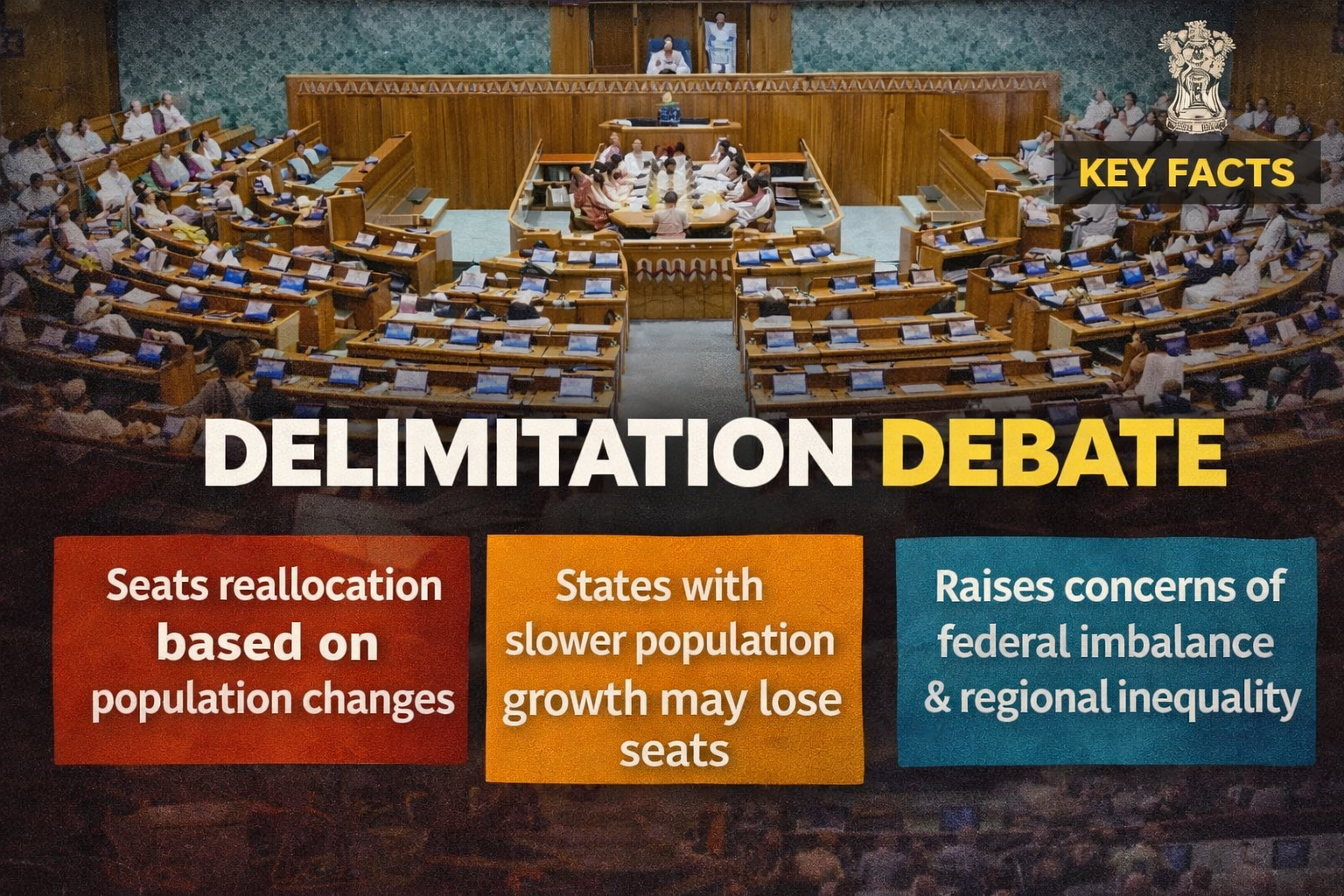
- Southern states fear loss of representation due to better population control.
- Northern states may gain more seats due to higher population growth.
- Raises concerns about federal imbalance and regional inequality.
- Enabling new delimitation is closely linked to the implementation of women’s reservation in legislatures.
What is Delimitation?
Delimitation is the process of determining the boundaries of territorial constituencies within a country to ensure fair representation in proportion to population changes. In India, this task is undertaken by an independent and authoritative body called the Delimitation Commission or Boundary Commission.
Objectives of Delimitation
- Equal Representation: Maintains balanced voter strength by rectifying disparities between overrepresented and underrepresented areas.
- Electoral Fairness: Realigns constituency boundaries with demographic changes to ensure just and accurate representation.
- Avoiding : Reduces major differences in constituency sizes, safeguarding the equity of democratic representation.
Constitutional Basis of Delimitation in India
- Article 82: Requires Parliament to pass a Delimitation Act after every Census and set up a Delimitation Commission.
- Article 170: Deals with the readjustment of territorial constituencies for State Legislative Assemblies following each Census.
Composition of the Delimitation Commission
Appointment: Constituted by the President of India in consultation with the Election Commission of India (ECI).
Members: Comprises a retired Supreme Court judge (Chairperson), the Chief Election Commissioner, and the concerned State Election Commissioners.
Independence: Operates independently, free from executive interference.
Authority: Its orders are final, not subject to judicial review, and cannot be altered by Parliament or State Legislatures.
Delimitation Commissions in India: Key Developments
1st Delimitation Commission (1951): Fixed the strength of the Lok Sabha at 494 seats and carried out delimitation of State Assembly constituencies based on population.
2nd Delimitation Commission (1961): Increased Lok Sabha seats from 494 to 522 and undertook readjustment of both parliamentary and assembly constituencies.
3rd Delimitation Commission (1971): Raised Lok Sabha seats from 522 to 543 and Assembly seats from 3,771 to 3,997; subsequently, the 42nd Constitutional Amendment Act (1976) froze delimitation until 2001 to promote population control.
4th Delimitation Commission (2001): Did not increase the number of seats but focused on boundary readjustments; the 84th Constitutional Amendment Act (2002) further extended the freeze on seat expansion until 2026.
- Missed Exercises: No Delimitation Commission was formed after the 1981 and 1991 Censuses due to prevailing political and demographic concerns.
- Freeze in 1976: Delimitation was suspended to promote population control, maintain federal equilibrium, and avoid regional conflicts arising from redistribution of seats.
Factors Driving the Need for Delimitation
- Correcting Population Imbalance: Large states like Uttar Pradesh have MPs representing over 25 lakh people, whereas smaller states have constituencies with fewer than 10 lakh voters, undermining the principle of equal representation.
- Managing Urban Overcrowding: Rapid urban migration has resulted in densely populated constituencies, leading to unequal voter distribution and the need for boundary readjustment.
- Reflecting Demographic Changes: High population growth states such as Uttar Pradesh and Bihar remain underrepresented, while states like Kerala and Tamil Nadu with lower growth fear reduced political influence.
- Promoting Electoral Equity: Continued delay in delimitation may deepen regional imbalances, giving some states disproportionate influence in governance and policymaking.
Challenges in Conducting Delimitation in India
- Federal Imbalance: States with lower population growth (mainly in the South) may lose seats, while high-growth northern states may gain, disturbing the existing political balance.
- Impact on Regional Parties: Regional and state-based parties could face reduced representation, weakening their role in national decision-making.
- Redrawing of Reserved Seats: Changes in population composition may alter SC/ST reserved constituencies, impacting established political dynamics.
- Delay in Women’s Reservation: Since women’s reservation is linked to delimitation, any delay in the process may postpone its actual implementation.
- Political and Legal Hurdles: Opposition from affected states and potential legal challenges may complicate and delay the exercise.
Concerns of Southern States
- Penalty for Population Control: States like Kerala, Tamil Nadu, and Karnataka may lose seats despite successfully controlling population growth.
- Political Marginalisation: Increased representation of northern states could reduce the influence of southern states at the national level.
- Economic Contribution vs Representation: Southern states contribute nearly 60% of India’s tax revenue but may experience reduced political weight after delimitation.
- Strain on Cooperative Federalism: Unequal representation could lead to tensions in resource sharing and policymaking, affecting the spirit of cooperative federalism.
Way Forward
- Conduct a fresh Census to ensure accurate representation.
- Build political consensus through all-party discussions.
- Consider alternative models to balance regional representation.
- Decouple women’s reservation from delimitation for timely implementation.
Conclusion
The defeat of the Constitution Amendment Bill underscores the complex interplay between electoral reforms, federal dynamics, and political interests in India. While delimitation is essential for democratic fairness, its execution must ensure regional balance and inclusivity. Moving forward, consensus-driven reforms and updated demographic data will be crucial to strengthen India’s representative democracy.
Practice Question “Delimitation in India reflects the tension between democratic equality and federal balance.” Discuss.
Source : The Hindu,18 April 2026 with inputs from Team Eduteria